
InnoBiz Global Consulting

Blog

Construction Risk Monitoring Dashboard: How EPC Companies Detect Project Risks Before They Become Million-Dollar Losses

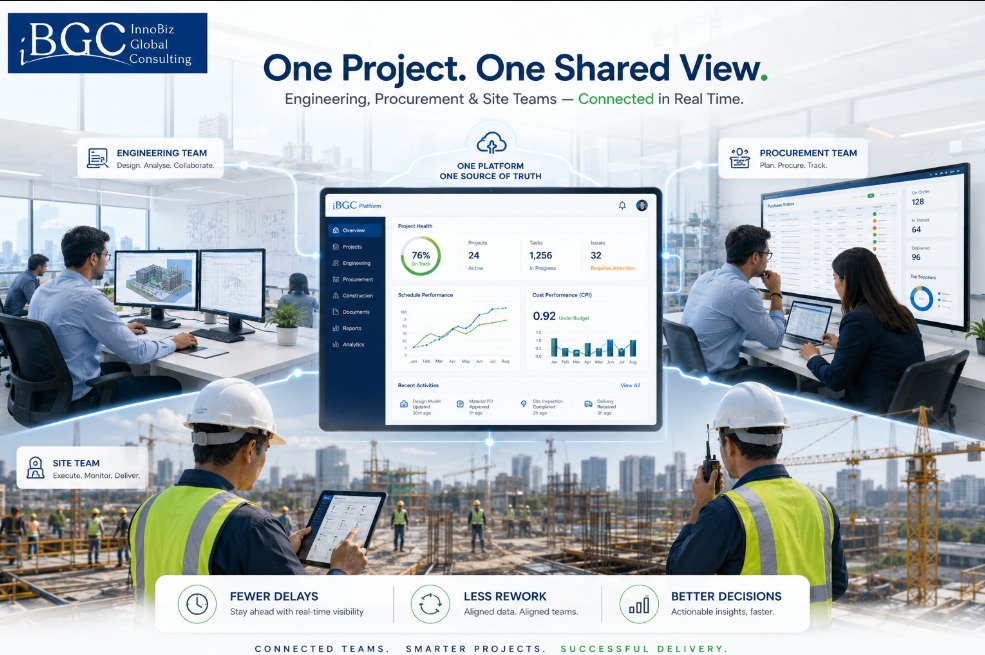
What if your leadership team could detect the warning signs 30–60 days earlier? Engineering, Procurement and Construction (EPC) companies operate some of the world’s most complex projects. Whether it’s highways, industrial plants, airports, metro rail, renewable energy, or oil & gas facilities, every project involves thousands of interconnected activities. Schedule slippage, procurement delays, rising costs, subcontractor performance issues, and cash-flow bottlenecks hardly occur overnight They develop gradually, hidden across spreadsheets, disconnected reports, and siloed systems That is exactly what a Construction Risk Monitoring Dashboard is designed to achieve. A modern Construction Risk Monitoring Dashboard transforms fragmented project data into a single source of truth, helping leadership teams detect risks before they escalate into million-pound—or million-rupee—losses. Key Features of an EPC Risk Monitoring Dashboard An effective Construction Risk Analytics platform should provide:                Monitor every active project through one executive dashboard.               Visualize project risks based on severity, probability, and business impact.               Use historical trends and AI-driven insights to forecast future project risks.               Identify schedule slippage weeks before milestones are missed.               Track forecast versus actual cash flow across projects.              Measure overall project performance using integrated KPIs.              Monitor hundreds of projects from one central location. Why Traditional Risk Management Is No Longer Enough              Identify issues before they affect project profitability.              Leadership teams receive accurate information without waiting for manual reports.             Track multiple projects through one executive dashboard.              Allocate manpower and equipment based on project priorities.             Monitor budget deviations before they become financial losses.            Transparent reporting strengthens relationships with clients and stakeholders. A modern Construction Risk MonitoringDashboard transforms this reactive approach into proactive decision-making by consolidating schedule, cost, progress, procurement, cash flow, and risk indicators into a single executive view Benefits of Digital Risk Monitoring for EPC Projects              Identify issues before they affect project profitability.              Leadership teams receive accurate information without waiting for manual reports.             Track multiple projects through one executive dashboard.              Allocate manpower and equipment based on project priorities.             Monitor budget deviations before they become financial losses.            Transparent reporting strengthens relationships with clients and stakeholders. How IBGC Helps EPC Companies Stay Ahead of Risk At IBGC, we understand that project success depends on timely decisions backed by reliable data. Our Construction BI solutions unify: Into a single executive dashboard that empowers project leaders to identify risks early, act faster, and maintain stronger control across the entire project portfolio. How to implement a Construction Risk Monitoring Dashboard. Implementation pitfalls to avoid. Whether you manage highways, rail, industrial plants, renewable energy, water, or commercial infrastructure projects, IBGC’s dashboards provide the visibility needed to reduce uncertainty and improve project outcomes. Organization’s that embrace predictive analytics, AI-driven risk monitoring, and executive dashboards gain a competitive advantage through faster decisions, stronger governance, and more predictable project outcomes. If your teams still rely on spreadsheets and static reports, now is the time to move towards intelligent, real-time project controls. Detect Risks Before They Become Costly Delays Gain complete visibility across schedule, cost, progress, cash flow, procurement, and project performance with IBGC’s intelligent Construction Risk Monitoring Dashboard. Request a Demo — See Your Project Risks Live
Blog

Seven Proven Ways EPC Software Controls Infrastructure Project Costs

Cost overruns on infrastructure projects rarely come from one dramatic failure, they build up from dozens of small visibility gaps, delayed approvals, and disconnected teams. Purpose-built EPC software addresses each of these points directly, which is exactly how EPC software reduces project cost overruns in a measurable, sustainable way. Organisations need connected project information, automated workflows, and real-time insights to control costs, reduce delays, and improve project outcomes By integrating planning, procurement, execution, document control, & financial monitoring, EPC software empowers project teams to make data-driven decisions throughout the project life cycle. 1. Real-Time Project Cost Visibility Modern EPC software provides live dashboards that display: Project managers can identify cost deviations early instead of discovering them at month-end. Real time project cost tracking software helps to take faster corrective action 2. Procurement Automation Reduces Material Cost Escalation Procurement delays create idle labour, equipment downtime, and rushed purchasing decisions. EPC software automates: This improves supplier coordination and reduces unnecessary procurement costs. Lower purchasing costs and fewer project delays Automated purchase requisitions, supplier catalogs, lead-time calculations, and PO consolidation optimize ordering. Integration with inventory and BOM prevents over-ordering and stockouts. Transparent, audit able change control shortens processing times and prevents unauthorised work from inflating budgets. 3. Better Resource Planning Improves Productivity Equipment sitting idle and labour waiting for materials directly increase project costs. With centralised planning, managers can monitor: The result is higher resource efficiency across multiple project sites. It continuous cost capture, integrated with procurement and time sheets, produces up-to-date burn rates and forecasts. Predictive analytics flag likely overruns before they materialize. Better productivity with fewer wasted resources 4. Early Risk Detection Prevents Expensive Delays Every infrastructure project contains hundreds of potential risks. EPC software enables: Reacting after problems occur become a costly affair, project teams can intervene before delays. Early warnings let managers reallocate resources, renegotiate rates, or adjust scope to avoid large deficits 5. Improved Change Order Management Uncontrolled design revisions are among the biggest reasons projects exceed budgets. A digital EPC platform tracks Modern change order management tools built into EPC software create a documented, auditable trail for every change: who requested it, what it costs, and how it impacts the overall budget. This discipline alone can prevent a significant share of avoidable overruns. For better scope control so every stakeholder works with the latest project information, reducing rework and disputes. 6. Accurate Forecasting Improves Financial Planning Executives need visibility into future project performance—not just current status. Advanced EPC software provides: Leadership teams can make informed decisions before financial issues escalate. More predictable project profitability, Project managers can identify cost deviations early instead of discovering them at month end. More predictable project profitability, Project managers can identify cost deviations early instead of discovering them at month end. 7. Centralized Collaboration Eliminates Information Silos Engineering, procurement, finance, and construction teams often work in disconnected systems.EPC software creates a single source of truth where all stakeholders access the same project data, reducing communication gaps and improving coordination. Many modern platforms are designed specifically to replace fragmented spreadsheets and manual reporting with integrated workflows.  A centralized repository ensures everyone,design, procurement, site, and finance, works from the same live dataset. Version control and audit trails reduce mismatches, RFIs, and clashes, cutting rework costs and contract disputes.  Faster decisions and fewer costly misunderstandings: Fewer change orders, faster approvals, and measurable savings in labor and materials. Engineering, procurement, finance, and construction teams often work in disconnected systems.EPC software creates a single source of truth where all stakeholders access the same project data, reducing communication gaps and improving coordination. Many modern platforms are designed specifically to replace fragmented spreadsheets and manual reporting with integrated workflows.  A centralised repository ensures everyone,design, procurement, site, and finance, works from the same live dataset. Version control and audit trails reduce mismatches, RFIs, and clashes, cutting rework costs and contract disputes.  Faster decisions and fewer costly misunderstandings: Fewer change orders, faster approvals, and measurable savings in labor and materials. How software helps: Linking schedule, resource loading, and cost in one model enables Earned Value Management (EVM), so you track planned value, earned value, and actual costs together Actionable checklist ( EPC) At IBGC Group, we help EPC and infrastructure organisations accelerate digital transformation with intelligent project management solutions that improve visibility, streamline collaboration, and strengthen cost control across engineering, procurement, and construction activities. Whether you manage highways, industrial plants, power projects, oil & gas facilities, or commercial infrastructure, our solutions are designed to support better planning, execution, and project governance “Book a Demo” – connect with product experts to map to your projects

AI Project Management Software for EPC
Blog

How AI Project Management Software is Transforming EPC Companies in India & GCC

Imagine automatically identifying procurement bottlenecks before they affect site execution. Engineering, Procurement and Construction (EPC) companies in India and the GCC are dealing with unprecedented kind of challenges, like complicated project lifecycles, tight deadlines , rising costs , and more pressure for transparency. Now AI project management software for EPC firms is stepping in as a real game changer, because it is reshaping how big infrastructure and construction projects are basically planned, executed, and delivered. Mega Infrastructure Projects and Competitive Pressure over the world are adopting AI faster EPC organizations are getting more pressure, like to finish projects faster, keep costs in check, push for better quality , and handle risks more carefully. The old-school ways of project management—spreadsheet tracking, disconnected systems, and those manual reports—just aren’t really enough anymore for today’s complicated infrastructure jobs. Artificial Intelligence is moving things along, pretty quickly, and it is reshaping how teams coordinate, forecast, and respond when problems pop up The Rise of AI in EPC Project Management Key Benefits of AI Project Management Software for EPC Companies Imagine knowing that a project will miss its deadline a few weeks before the delay, actually happens. Imagine being able to automatically spot procurement bottlenecks before they start affecting site execution, even quietly. Imagine dashboards that keep watching thousands of project activities, and then suggest corrective actions in real time, nonstop. So, are you ready to transform your EPC project and avoid these crises across your organization? This is no longer a vision of the future. It is exactly what AI Project Management Software for EPC Companies is delivering today. Explore how AI can optimize your construction lifecycle with IBGC Group

Blog

AI is Revolutionizing UX Research: Are You Ready?

The way we gather user insights is evolving! AI is making waves in product management, and UX research is at the forefront of this change. Here are some fascinating trends that organizations (and UX researchers) need to know: Automating Mundane Tasks: Say goodbye to tedious data analysis! AI can sift through mountains of user feedback, identifying trends, sentiments, and pain points much faster. More time for deeper insights! Uncovering Hidden Gems: AI can analyze user behavior patterns you might miss. Imagine uncovering user frustrations through subtle cursor movements or hesitation points! Conducting Super-Efficient User Testing: AI chatbots can conduct basic user testing 24/7, gathering valuable feedback from a wider range of users at a fraction of the cost. Creating Personalized User Journeys: AI can personalize the user testing experience, tailoring questions and scenarios to individual user profiles. Democratizing UX Research: AI tools are becoming more user-friendly, making UX research accessible even to smaller teams with limited resources.         The Future is Now: These are just a few ways AI is transforming UX research. Are you ready to embrace this exciting future? Share your thoughts in the comments! #UXResearch #AI #ProductManagement #Innovation

Blog

Importance of Business Intelligence role in your current industries

Unlocking Success: Understanding the Importance of Business Intelligence In the landscape of modern business, the power of data reigns supreme. In a world brimming with information, harnessing this data has become a strategic necessity. This is where Business Intelligence (BI) steps in, transforming raw data into actionable insights and steering businesses towards success. What is Business Intelligence? Business Intelligence encompasses a set of technologies, strategies, and practices used to gather, analyze, and convert raw data into meaningful and actionable insights. It involves tools that aid in the interpretation of large volumes of data to support decision-making processes. Why is Business Intelligence important? Implementing Business Intelligence: Implementing BI involves several crucial steps: Conclusion In today’s dynamic business environment, Business Intelligence is not merely an option but a necessity. It empowers organizations to adapt, innovate, and thrive in the face of constant change. The insights derived from BI are not just numbers; they are the guiding lights illuminating the path toward success. Harness the power of Business Intelligence and unlock the full potential of your business.

Blog

Unlocking Business Potential with Data Lakes

Businesses have a wealth of options to harness the power of information for strategic decision-making and growth in today’s data-driven environment. Data lakes have become a game-changing tool for businesses trying to manage, store, and analyze massive amounts of data. In this blog post, we’ll look at how data lakes can advance your business and users in a new era of commercial success. *Understanding the Data Lake Advantage* Data lakes are more than just a buzzword; they’re a strategic asset that empowers businesses to:   *A Path to Competitive Advantage* Numerous sectors, including healthcare, banking, retail, and manufacturing, might profit from data lakes. Here is how data lakes can provide businesses a competitive edge:   *Embrace the Data-Driven Future* Data is more than just a resource in today’s fast-paced corporate climate; it’s essential to success. Data lakes allow businesses to fully utilize their data, unlocking insights, lowering costs, and maintaining a competitive edge. If you’re prepared to advance your company, think about putting a data lake strategy in place. Join forces with Business Intelligence Global Consulting Services, and let us show you the way to excellence driven by data. Together, we can use your data as a strategic advantage to advance your business in the digital era.  

Scroll to Top